

Healthy Eating for Fall
Healthy Eating for Fall
The season of fall brings cooler weather and shorter days. As with any season, the world adjusts accordingly. Plants begin to go dormant, animals start scrounging for food to help get them through the upcoming winter months and humans start winterizing everything. Sweatpants and hoodies become more commonplace and everything…EVERYTHING is pumpkin flavored.
As fall descends on the land, it reminds us we need to start cutting back on the numerous cooling foods that are consumed during the summer months. Things like raw foods, salads, juices and fruits need to be decreased because they can create too much cold in the body. This is just one principle followed by Traditional Chinese Medicine.
There are many facets to TCM and nutrition is one of the most important. The ancient Chinese observed what took place in nature and followed those cues accordingly. So when the season changed to fall and the amount of daylight decreased and the temperatures cooled, the Chinese began to eat what was available. This is what it means to “eat for the season.” By eating according to the season, we can avoid many illnesses and diseases. If we continue to eat raw, cold foods during the cooler fall and winter months, then we set ourselves up for digestive problems, colds, sinus infections and even painful joints.
When a person eats seasonally, they will inevitably notice certain foods are no longer abundant or available. In the season of fall, one should fill their pantry and cupboards with dried foods, heavy grains, seeds, roots and squashes that can help move the body’s energy or Qi (pronounced “chee”) inward.
This means we should cook food for longer periods of time on lower heat. How we cook food will affect how the body tolerates it and how the energy is utilized. Some examples of how to cook for the season of fall include making soups and stews, using a crockpot or slow cooker, roasting and baking foods. These methods create a deeper warmth and supply greater energy from the food.
Foods that are nourishing to the lung are very important during the season of fall. Since many people get sick during these months, lung tonifying foods can be very beneficial. This includes foods like ginger, onion, garlic, pears, walnuts, miso, navy beans, almonds asparagus, broccoli, apricots, bananas, apples, plums and grapes.
The dryer weather can also cause chapped lips, a dry nose, an itchy throat, rough skin and even dry stools. To counter these issues, it is recommended to eat foods that promote the production of bodily fluids, such as nuts, seeds, pears, pumpkin, honey and a traditional Chinese porridge known as congee.
Animal products tend to be warming and grounding by nature. And for those who eat animal flesh, increasing the intake can be beneficial during the cooler fall months. As mentioned before, roasting, baking or stewing the meats is the most beneficial.
When we follow the cues given to us by nature, we can maintain a very healthy existence. To learn more about eating according to the seasons in Traditional Chinese Medicine, contact your local acupuncturist or TCM practitioner.
Info from © Acupuncture Media Works/AcuDownloads • www.acupuncturemediaworks.com

Healthy Eating for Summer
Healthy Eating for Summer
Traditional Chinese Medicine is a medical system thousands of years old and incorporates many different modalities. TCM theory emphasizes Mother Nature provides the right kind of food for the right kind of environment. For instance, if the weather is cold, then warming, nutrient-dense foods are best for the body. Likewise, when summer rolls around, it is best to partake of cooling foods and foods that are abundant during this season.
Summer is a time of great abundance. Or as the Chinese refer to it, the time of utmost yang. The days are longer and warmer. And everything and everybody seems to be more active. The warmth of the summer sun encourages growth and maturation. In TCM, summer relates to the element of fire and the heart and small intestine energetic pathways or meridians. Because summer is a time of growth, many fruits and vegetables become abundant during the season. And because the season tends to be the warmest, it is important to stay cool and hydrated.
The body is thought to contain a substance the Chinese call Qi (pronounced “chee”). This Qi is frequently translated into the term energy in English. When a person’s Qi is low, then a deficiency develops. Conversely, when there is an excess of Qi, problems may arise indicative of this. Sweat is the fluid of the heart. When a person sweats excessively, the Qi of the heart becomes scattered and weak. This can weaken the mind and cause symptoms like depression, restlessness, insomnia and irritability. But this can be countered by eating foods salty and sour in nature. This includes foods such as miso, pickles, lemons, limes and sour plums.
The summer months are generally hot and therefore the body needs to be kept cool. This is the perfect time to eat more raw foods that clear heat. But as with anything, don’t overdo it. Too much cold or raw foods can wreak havoc on the digestive tract causing spasms, tightness and contractions. This will make the body work harder to warm the food being eaten, which can then deplete the Qi of the spleen and stomach meridians. Therefore cooked foods and even soups are still recommended during the warm summer months. They are usually made with seasonally-available foods or eaten at room temperature to avoid any digestive conflict.
It is best to avoid heavy, greasy and fried foods during the summer months, as they can clog up the digestive system. They can also create excess phlegm in the lungs leading to respiratory problems. And when cooking during the season of summer, it is best to create meals quickly and simply by grilling or stir frying.
Examples of foods beneficial for the summer months include peppers, eggplant, cabbage, kale, broccoli, spinach, melons of all kinds, beets, berries, pineapple, cucumbers, grapefruit and mushrooms. If you need more help understanding or designing a proper seasonal-eating plan, contact your local acupuncturist or TCM practitioner. They will definitely be able to help you identify what plan works best for you.
Herbal Poultices for Skin Conditions
Herbal poultices are a great way to provide quick relief to a variety of ailments that could affect your body. Technically, a “poultice” simply means to apply a moist combination of herbs directly to your skin. There are many different kinds of herbal poultices and some differ greatly from the next. Certain poultices may combine multiple herbs with different liquids, and some could only contain one type of herb and one type of binding liquid, such as distilled water. In addition, poultices can be applied with a thin cloth or bandage, instead of directly to the skin.
Here are two herbal poultices you can make at home to use for certain ailments. When creating these poultices you can decide whether you wish to apply directly to your skin, or to use a thin cloth, adhesive or bandage. To create poultices it is important to have a pestle and mortar to crush and combine your herbs.
Insect Bites - Try your hand at making a plantain poultice. You can place this poultice directly on the skin without any type of cloth or bandage to contain it together. You can mash fresh or dried plantain and combine with a bit of distilled water in order to create this poultice. This poultice is also known to be helpful at treating boils.
Inflammation or Infection - Create a mustard poultice, mash mustard seeds and then mix with clean distilled water or a natural oil, and apply. For this poultice, it is recommended to put the created paste in a thin cloth, which you will then place on your skin. Mustard poultices have been known to burn the skin if they make direct contact, so make sure to use a thin cloth or adhesive. Mustard poultices can help heal inflammation, infection and abscesses.
Info from © Acupuncture Media Works/AcuDownloads • www.acupuncturemediaworks.com

Headache Pain
Headache Pain
Meridian Exercise for Headaches
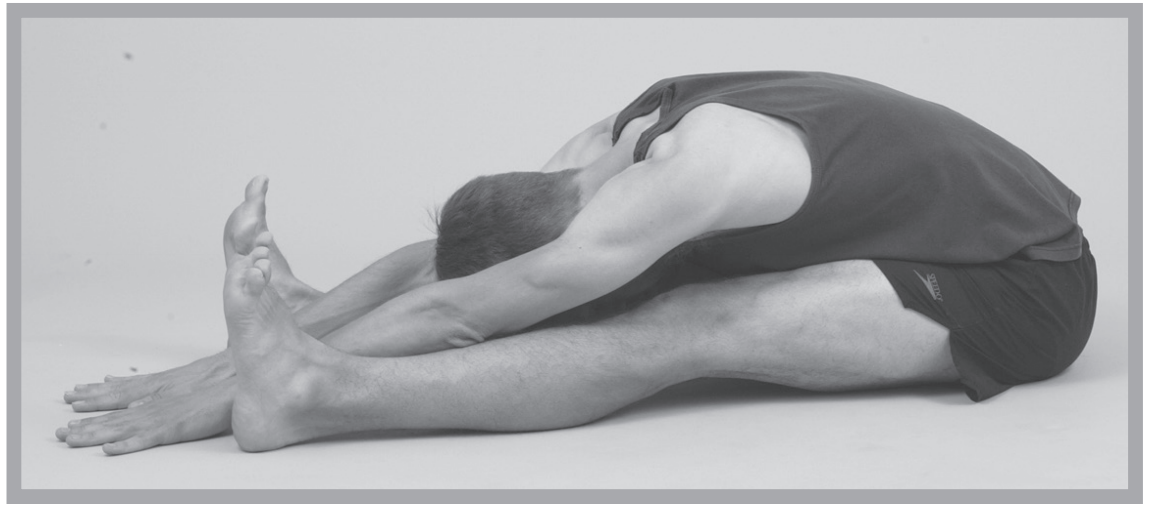
Forward Bend Exercise
1. Sit on the floor with legs stretched out in front of you. Keep your knees slightly bent, do not lock them. If this causes any discomfort, you can sit on a folded blanket and bend your knees slightly out to the side.
2. With chin slightly tucked, slowly stretch forward, reaching your hands toward your toes. If you cannot touch your toes, reach for your knees, shins or ankles. Relax your head.
3. As you breathe in, focus your breath along your back and spine. Expanding outwards with each inhalation, and imagining that you are expanding your back like a big balloon. As you exhale, allow your body to relax deeper into the stretch. (See image below)
4. Hold this position for a few breaths.
Helpful Aromatherapy For Headaches and Migraines
Fill a small glass, 1oz. jar or bottle approximately 2/3 full with Sweet Almond Oil.
Add:
• 6 drops Lavender Oil
• 6 drops Clary Sage Oil
• 6 drops Chamomile Oil
• 12 drops Peppermint Oil
• Cover and shake. Check the fragrance of the oil.
• Fill any remaining space in the bottle with Sweet Almond Oil.
To use: Apply to temples and areas of pain. Massage lightly. You can also put some on the back of your hand, on the Large Intestine 4 point.
Other aromatherapy oils for headaches:
• Lavender
• Peppermint
• Bay
• Melissa
• Jasmine
• Eucalyptus
Acupressure Points
Rubbing acupuncture points with your finger for 30 - 60 seconds can stimulate and promote the circulation of Qi within your own body, restoring health and well-being.
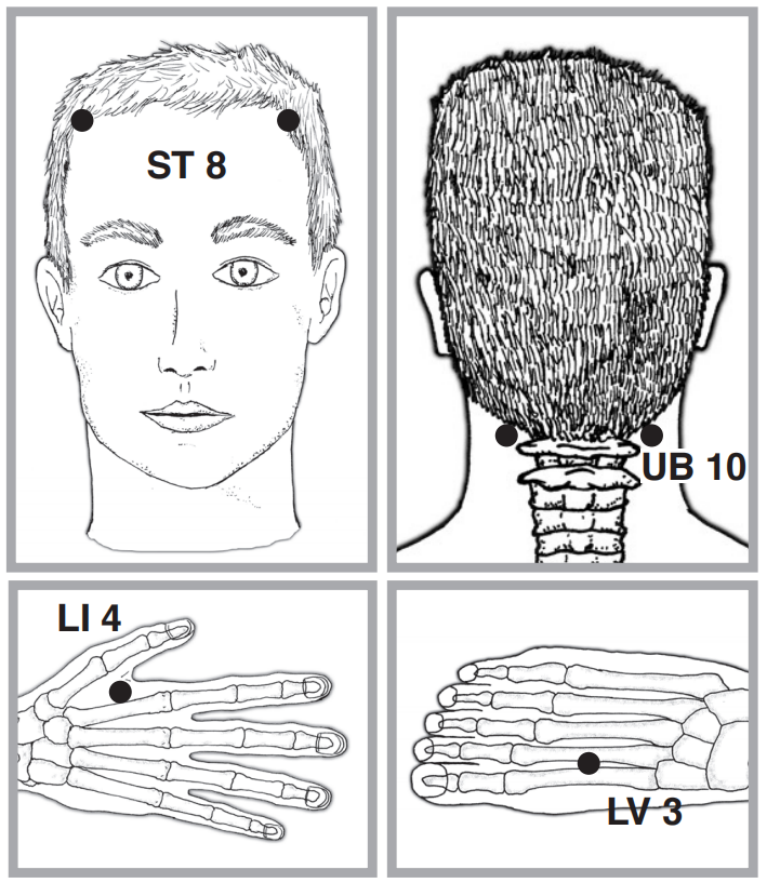
Liver 3 (LV 3): On the top of the foot, in the depression between where the first and second metatarsal bones meet. Functions: Used for dizziness, headaches, vertigo, epilepsy, painful and/or blurry eyes, irregular menstruation, depression, uterine bleeding and prolapse, urine retention, genital pain, frequent sighing, and insomnia. DO NOT USE DURING PREGNANCY.
Large Intestine 4 (LI 4): On the back of the hand between the thumb and first finger. In the fleshy part of the hand. DO NOT USE DURING PREGNANCY. Functions: Used for common cold with sweating, fever, headache, red, painful eyes and nasal congestion. Known as “The Master Pain Elimination” point, it can address pain in many parts of the body. Also used for throat constriction and dysentery. Regulates the Wei Qi (Chinese theory of immune system).
Stomach 8 (ST 8): Approximately 4.5 inches from the middle of your head, at the corner of the forehead, a few inches in from the hairline. Functions: Used for dizziness, eye disorders and spasms, facial paralysis, headaches and migraines, lacrimation, mental disorders, and visual disturbances.
Bladder 10 (UB 10): Approximately 1.5 inches lateral to the middle of the neck, in a depression. Functions: Used for dizziness, eye disorders, headaches, migraines, stiff neck and pain.
Info from © Acupuncture Media Works/AcuDownloads • www.acupuncturemediaworks.com

Healthy Eating for Spring
Healthy Eating for Spring
Spring is a time of renewal, regeneration, growth and energy. Plants and animals awaken from their slumber during the cold winter months, and vital nutrients stored in the roots of plants come to the surface as life becomes more vibrant and fluid.
Human beings are no different. Humans stay indoors more during the winter months, and tend to pack on a little extra weight in the process. As the weather warms, humans become more gregarious and spend more time outside enjoying nature. This is just a natural process.
Therefore, it makes sense that what was observed by the ancient Chinese should still hold true today. Humans are supposed to take their cues from nature. As a species, humans should be more active during the warmer spring months. And to do this, we need proper nourishment. Qi (pronounced “chee”) is sometimes translated into energy. This Qi is the vital substance that keeps our bodies functioning until the day we die. To keep the Qi plentiful, we need to eat the proper foods at the proper times.
During spring, we should be eating foods that have upward energies, such as green, sprouting vegetables. But we also need foods that will provide the extra nourishment for the increased amounts of activity that accompany the season of spring. This is where sweeter foods play a vital role. Foods such as fruits, nuts, yams, carrots and potatoes can provide the extra energy needed during the spring. But be careful not to overdo it. Too much sweet can overload the body and make it sluggish.
Sweets should be countered with pungent foods. Pungent foods aid in the movement of Qi upwards and outwards through the process of perspiration. Pungent flavored foods include scallions, onions, ginger, radishes, garlic, leeks and chives.
According to Traditional Chinese Medicine theory, spring is the season of the liver and the gallbladder. These organs regulate a smooth flow of energy throughout the whole body. However, they are prone to stagnation because we do not take proper care of ourselves. This can manifest as anger, irritability, depression, insomnia and even pain. Stagnation can occur when people eat too many poor-quality foods that may be full of chemicals.
Foods that help ward off stagnation include foods rich in chlorophyll, such as wheat grass, spirulina, chlorella, parsley, kale, Swiss chard and collard greens. All of these foods are abundant during the months of spring. It is also a good idea to have a glass of warm water with a slice of lemon first thing in the morning. This will help detoxify the liver and gallbladder to start the day offfresh. Lastly, foods that have a slightly bitter taste can help ward off heat in the liver. This includes foods like asparagus, quinoa, romaine lettuce and dandelion tea. If you are curious about how to eat according to the seasons, talk to your acupuncturist. They will be able to guide you along your healing journey through the use of Traditional Chinese Medicine and nutritional counseling.
Stir-fry For Your Health
If you are looking to spice up your family meal this spring, why not try a healthy chicken stir-fry. A meal that is colorful, warm, seasonal and easy to make.
In Traditional Chinese medicine and Five Element theory, food is medicine. Not only is food healthy and nutritious biochemically, but it also has properties in temperature, taste, color and shape that benefit specific organs. Colors and taste benefit certain organs, for example, sour and the color green go to the liver. Pungent flavors such as garlic, ginger and onions benefit the lungs. Dark and salty foods like seaweed benefit the kidneys. The best thing to remember is to eat fruits and vegetables that are in season and try to add color to your food to encourage the healthy actions the organs have in the body. Warm and cooked vegetables are easier on the digestion than cold and raw food. A terrific item to add to the cooking schedule is a colorful and tasty stir-fry.
A stir-fry has a healthy variety of colors, vegetables, meat, spices and seasoning. Typically what goes into a stir-fry includes chicken, soy sauce, oyster sauce, rice vinegar, honey, garlic, ginger, onion and rice.
Preparation is simple and you can find countless recipes by conducting an Internet search. Typically, a recipe will look like this:
1 lb. chicken
1 tbsp cornstarch
2 tbsp soy sauce
2 tbsp oyster sauce
1 tbs rice vinegar
1 tbs honey
3 cloves garlic
1 tbsp ginger
green onion to taste
Marinating the chicken overnight adds richer flavor, if you so choose. Combine cornstarch, soy and oyster sauce, rice vinegar, honey and garlic. Stir fry in chicken until brown, set aside. Add vegetables and cook until crisp. Stir in chicken, add onion, peanuts or other things to taste. Serve over rice.
Info from © Acupuncture Media Works/AcuDownloads • www.acupuncturemediaworks.com

Spice Up Your Medicine Cabinet!
Friday, June 10th is National Herb and Spice Day, a day to celebrate the diversity of flavors available to us through the powerful plant parts that have come to be known as herbs and spices. While this tradition is relatively recent in origin (first celebrated in 1999), the wonder of herbs and spices have been recognized throughout history, and not just for their culinary contributions. Former Holy Roman Emperor Charlemagne (742-814 AD) had 74 different herbs growing in his garden and was quoted as saying:
“Herbs are the friends of physicians and the praise of cooks”
In Europe, by the middle ages, herbs and spices were commonly used in both cooking and medicine. As far back as around 2700 BC in Ancient China, however, a historical work known as The Classic Herbal mentioned more than a hundred medicinal plants, including cinnamon. It has been said that advisors to the royal court in China during the 3rd century BC carried cloves in their mouth so their breath was fresh when they addressed the emperors. In the 5th Century AD, according to Chinese records, ginger was carried on long sea journeys to prevent scurvy, as well as to delight the taste buds.
Any student or practitioner of Chinese Medicine knows that Chinese food therapy (which includes many applications of medicinal herbs) was well documented in The Yellow Emperor’s Classic dating back to the Han Dynasty (206BC-220AD). So, if your medicine cabinet is looking a little bare, spice it up! If you’ve got some of these common seasonings in your kitchen, you’ve actually got a pretty well stocked medicine cabinet!
It’s good to know you’ve got some health resources right in your own spice cabinet, but it’s even better to know you’ve also got your local acupuncturist/herbalist on hand with even more tools to support your well-being. We’re here for you and look forward to seeing you at your next appointment!
Cinnamon: One of the most ancient spices still in use, the bark (Rou Gui) of the Cassia tree benefits circulation, and warms the body to expel cold and alleviate pain. Cinnamon is known to help support the body’s yang energy to stop diarrhea and even help with wound healing.
Ginger: Probably the most common seasoning in Chinese cooking, this root is used both fresh and dried. You may have the dried version in your cabinet as a powder. Dried ginger (gan jiang) is warming, aids in digestion, and boosts the qi for alleviating feelings of cold and fatigue.
Turmeric: Turmeric (jiang huang) is a root from a flowering plant related to ginger. It strongly moves the blood to unblock stasis, helping to ease arthritic, menstrual, and chest pain and to support liver health.
Clove: The penetrating aroma of clove (ding xiang) comes from the flower buds of a tree and when taken internally imparts a strong warming energy that boosts yang qi in the body. They can help with hiccups, vomiting, diarrhea and abdominal pain.
Pepper: If you can’t find any of the other spices mentioned, you probably at least have this one on hand. Peppercorn (hu jiao) is the fruit of a flowering vine that warms the core of the body, descends rebellious qi and dissipates phlegm to help with abdominal pain, vomiting, congestion, and epilepsy.
Mint: While many of these spices are considered warming. Mint leaves (bo he) are actually very strong in their ability to cool the body while promoting sweat and can ease symptoms of cold and flu, help with headaches and menstrual cramps.
Garlic: In addition to scaring away vampires, this plant bulb (da suan) that is technically considered a vegetable (like an onion), is warm and dispersing. It is known for its ability to kill parasites, relieve toxicity to treat food poisoning, and can help clean the blood and reduce clotting.
Thyme: Much more than a delicious pizza topping, this herb was used by ancient Greeks and Romans as a way to stimulate courage. The Chinese use these shrub leaves (bai li xiang) to tonify qi and warm the lungs. It has been used to treat cough and shortness of breath, and to strengthen immunity and digestion.
Info from © Acupuncture Media Works/AcuDownloads • www.acupuncturemediaworks.com

Top Benefits of Acupuncture
Acupuncture is part of Traditional Chinese Medicine (TCM) and is practiced in many different forms which include herbal remedies, cupping, and massage, which have all been used for thousands of years. The basis of TCM is the idea of qi, the body’s vital energy. TCM treatments promote the movement of qi throughout the body in order to help bring balance back to the body. The goal of acupuncture is to correct this imbalance which can cause a variety of ailments and conditions that you may currently have. Acupuncture uses very thin needles (which have been compared to being as small as cat whiskers) that stimulate pressure points and other areas of your body. It stimulates qi by placing needles in specific spots, often along meridians. Meridians are the channels that qi travels in the body.
Acupuncture can help with many health conditions, including:
• Arthritis
• Chronic pain, including joint pain
• Depression
• Headaches and migraines
• Trouble sleeping and insomnia
• Nausea and digestive trouble
• Back pain and sciatica
• Stress and anxiety
• Tinnitus (ringing ears)
• Weight loss
Here are the top five ways that acupuncture can help
1. RELIEVES PAIN
Acupuncture can help alleviate many types of pain that may range from headaches and migraines to neck and back pain. These studies have shown its effectiveness in treating lower back pain, migraines, tension headaches, and knee pain. Acupuncture works differently for everybody. For some, a single treatment can alleviate symptoms for several months while others need a more routine treatment schedule.
2. IMPROVED SLEEP
Another thing that Acupuncture can help improve is sleep and insomnia. Scientists believe that acupuncture increases the production of brain chemicals that promote relaxation, thus allowing for better sleep.
3. UPLIFT MOOD
Acupuncture can help with improving mood, including helping with depression, stress, and anxiety. The needles from acupuncture treatment release endorphins in the body. Endorphins are hormones that provide a boost in mood, encouraging happiness and relaxation.
4. HELP THE HEART
Acupuncture is also good for your heart due to the relaxation and stress reduction that one achieves from the treatments, which are also known to reduce blood pressure. Stress and high blood pressure are commonly related to heart attacks and heart disease.
5. SUPPORT THE IMMUNE SYSTEM
Research has shown that acupuncture can boost immune system function. The placement of acupuncture needles can release immune-boosting cytokines. Cytokines are messenger cells that regulate the body’s immune response. By triggering the immune system, acupuncture can help fight infections or illnesses like colds and the flu.
Info from © Acupuncture Media Works/AcuDownloads • www.acupuncturemediaworks.com

New Research Might Help Explain How Acupuncture Works
One of the theories scientists have held for many years as to why acupuncture works to alleviate chronic pain and other ailments is called the Vascular-Interstitial Theory. This theory describes the idea that acupuncture works by affecting the electrical system of the body, the network of currents conducted by our cells. Electricity is vital for sending information through the body to the brain and vice versa, as well as in order to conduct currents to the heart, which allows it to pump at the right times.
A disruption to any of these electrical currents can cause illness. The Vascular-Interstitial Theory of acupuncture suggests stimulating acupoints affects these electrical currents in our bodies, facilitating healing by allowing the transfer of blood, organic matter and electrical energy between healthy and injured tissues.
Research published in March 2018 in Scientific Reports offered a significant contribution to our understanding of the interstitium, and therefore sheds new light on the Vascular-Interstitial Theory.
Previous research on the interstitium suggested it was a layer of densely packed connective tissue lining the digestive tract, lungs, urinary systems and surrounding veins and fascia between the muscles. New and increasingly powerful microscopes now allow scientists to look inside living tissues. In this case, the authors of the research were able to look inside the interstitium for the first time, and rather than a web of densely packed connective tissue, they found the space is a network of interconnected, fluid-filled compartments. This finding may help to explain why placing acupuncture needles at specific points on the body creates healing elsewhere in the body.
In an article for The Cut, reporter Katie Heaney interviewed one of the authors of this new research, Neil Theise, a clinician and professor of pathology at NYU Langone Health and a proponent of alternative medicine. While the research paper itself did not discuss acupuncture, Heaney asked Theise to weigh in on the possible connections. Theise posited it was possible the research had implications for understanding acupuncture. The layer of skin into which acupuncture needles are inserted is the interstitium, Theise explained.
“There’s fluid in there,” he told Heaney. “When you put the needle [into an accu-point], maybe the collagen bundles are arranged into a channel through which fluid can flow.”
The research shows the interstitium is a structured and organized system in the body. It may be that stimulating true acupoints allows interstitial fluid to travel throughout the body, explaining why acupuncture has far-reaching effects, not just offering pain relief at the site where the needles are inserted. Channels of interstitial fluid may be responsible for facilitating the transfer of blood, organic matter and electricity between healthy and injured parts of the body. These findings also offer a possible explanation as to why other research has shown sham acupuncture points have some pain-relieving effects where the needles are inserted, but true acupoints go a lot further in offering system-wide relief.
As always, this research is inconclusive on its own. It will require more research to further explore the connection between the interstitium and acupuncture, but it is undoubtedly an interesting idea.
Info from © 2019 Acupuncture Media Works/AcuDownloads • www.acupuncturemediaworks.com